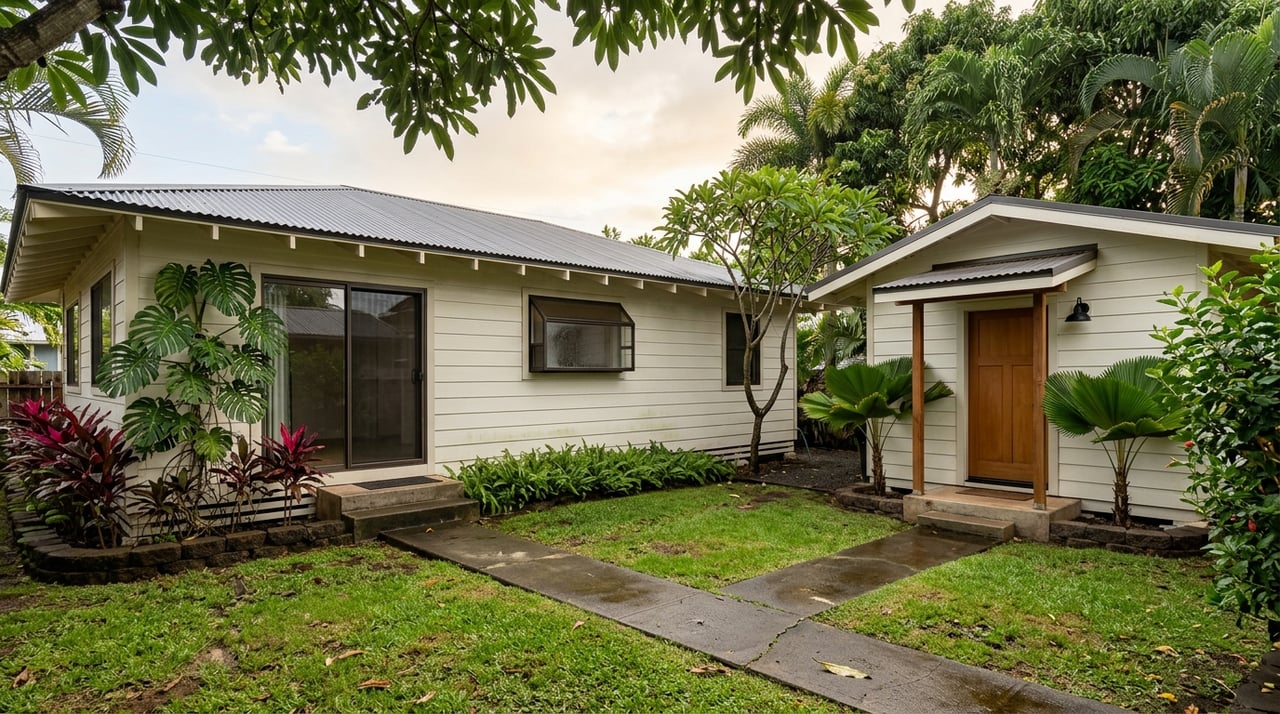
If you are thinking about investing in Hilo, the opportunity is real, but so is the need for careful planning. This is a market where long-term rental demand has solid local drivers, yet numbers can tighten quickly if you rely on headline rents or assume every extra unit is legal. In this guide, you will learn how to think about ohana units, duplexes, and long-term rentals in Hilo so you can make a more informed decision. Let’s dive in.
Why Hilo attracts long-term renters
Hilo has an established housing market with a population of 44,186, a median household income of $81,779, and a median owner-occupied home value of $483,000. The Census also reports a median gross rent of $1,427 and an owner-occupied housing rate of 66.1%. Taken together, that points to a market with a meaningful renter base and price-sensitive demand.
Just as important, Hilo has steady employment and institutional anchors that support long-term tenancy. Downtown Hilo serves as the county government seat, UH Hilo has total enrollment of 2,781 students, and Hilo Benioff Medical Center reports 1,500 employees across 33 specialties. Those employers and institutions can support demand from county staff, students, faculty, healthcare workers, and people relocating to the area.
That does not mean every rental property will perform the same way. It means Hilo has the kind of year-round activity that can make long-term rentals worth a closer look when the property, zoning, and numbers line up.
What rents look like in Hilo
One of the first challenges for investors in Hilo is that rent data does not come from one clean source. Recent spring 2026 snapshots show average asking rents at $1,726 on Redfin, $2,077 on Zillow, and $2,200 on Trulia. Since each platform uses a different method, it is best to treat these numbers as a range rather than a single market fact.
That range matters because it can create unrealistic expectations. The Census median gross rent is lower at $1,427, which suggests some asking-rent headlines may sit above what many existing rentals actually achieve. If you are underwriting a purchase, you will want to compare current asking rents with the actual rent roll, condition, unit count, and likely operating costs.
For more conservative planning, Hawaiʻi County’s 2026 payment standards for Area 2, which includes Hilo ZIP code 96720, were $1,276 for a one-bedroom and $1,658 for a two-bedroom. These are not market rents, but they can help you build a lower-risk long-term rental scenario.
Ohana units in Hilo
Ohana units can be appealing in Hilo because they may create extra rental income on a property that already has a primary home. In Hawaiʻi County, an ʻohana dwelling unit is treated as a second dwelling unit and may be allowed in RS, U, RA, and A districts on a legal lot of record, subject to county rules. That makes them a real option, but not a shortcut.
County rules also matter at the property level. The code says an accessory dwelling unit may not exceed 1,250 square feet of living area, may be built as a duplex with a single-family dwelling, and is limited to three per building site. Some parcels are excluded, including conservation-district sites and properties where a change-of-zone ordinance prohibits the use.
This is where due diligence becomes essential. Before you count income from an ohana unit, confirm whether it is a legally permitted ADU, a designated accessory unit, or an unpermitted conversion. The County of Hawaiʻi Planning Department’s Administrative Permits Division handles ohana and farm dwellings, so permit history and compliance should be part of your review before you move forward.
Questions to ask about an ohana unit
- Is the lot in a district where an ohana unit is allowed?
- Is the lot a legal lot of record?
- Was the structure permitted as an ADU or accessory unit?
- Does the living area stay within county size limits?
- Are there any zoning or change-of-zone restrictions on the parcel?
- Has the seller provided permit records or documentation for the unit?
Duplexes and small multifamily in Hilo
If you want simpler income-property underwriting, duplexes and small multifamily properties can be easier to evaluate than a single-family home with an uncertain second unit. Hilo has a zoning framework for multiple-family residential districts, but many smaller income opportunities are older properties rather than new apartment inventory. That means condition, deferred maintenance, and legal use status often matter as much as gross rent.
In the local market, some opportunities may involve legacy structures with legal nonconforming use. A recent Hilo three-unit rental listing was marketed at a 7.68% cap rate and described as a legal nonconforming use. That is only one example, not a market average, but it shows the type of asset local investors may come across.
Older small multifamily properties can offer upside, especially if rents are below market or units need operational improvements. At the same time, they can bring more complexity around maintenance, insurance, and compliance. In Hilo, that tradeoff should be part of your investment decision from day one.
How to underwrite Hilo rentals conservatively
A quick back-of-the-envelope number can help you frame the market, but it should never be your final answer. Using Census medians, Hilo’s implied gross rent-to-value ratio is about 3.5% before expenses. That is only a rough inference, not a cap rate, and it leaves out taxes, insurance, repairs, vacancy, and reserves.
For broader commercial real estate context, a 2026 cap-rate guide from LoopNet places multifamily in a tertiary-market range of 5.5% to 8.0%. For smaller island income properties like those often found in Hilo, that tertiary band can be a useful comparison point, especially for older buildings or value-add deals. Still, it is not a published Hilo-specific metric, so it should be treated as context rather than a rule.
The practical lesson is simple: buy based on verified income and real expenses, not optimistic rent assumptions. A property may look attractive when you plug in top-of-range asking rents, but the deal can feel very different once you add property taxes, insurance, maintenance, turnover costs, and cash reserves.
A better Hilo underwriting checklist
- Verify the current rent roll and lease terms
- Review permit history for all units and additions
- Estimate taxes, insurance, and routine maintenance
- Budget reserves for repairs and vacancy
- Compare in-place rents with realistic long-term rent scenarios
- Confirm whether the property’s legal use matches how it is being marketed
Long-term rentals versus short-term strategies
For many investors in Hilo, long-term rentals may be the more straightforward path. Hawaiʻi’s Department of Taxation says rental proceeds are subject to Hawaiʻi income tax and the general excise tax. Long-term rentals of 180 consecutive days or more must register for a GET license and file GET returns, while shorter stays also trigger transient accommodations tax rules.
Hawaiʻi County adds another layer through property tax classification. The county’s 2026 assessment insert says properties with commercial or short-term rental activity of less than six months do not qualify for the homeowner tax class. It also says long-term rental activity of six months or more can still fit within homeowner-tax-class rules if the owner otherwise qualifies.
That distinction can matter a lot to your bottom line. If you are comparing a steady long-term lease with a shorter-stay strategy, taxes and classification should be part of the analysis, not an afterthought.
Landlord rules every Hilo investor should know
If you plan to own a long-term rental in Hilo, you should understand Hawaiʻi’s landlord-tenant rules before you buy. For month-to-month tenancies, landlords generally must give 45 days’ written notice to terminate, while tenants must give 28 days’ notice. Month-to-month rent increases also require 45 days’ notice, and Hawaiʻi does not have rent control.
Security deposit rules are also specific. The state handbook says the security deposit is capped at one month’s rent, with an additional pet deposit of up to one month’s rent allowed. After termination, deposit accounting and any remaining funds generally must be returned within 14 days.
Entry and repairs matter too. Landlords generally need to give at least two days’ notice before entry, except in emergencies. The state handbook also outlines repair timelines of three business days for emergencies and 12 business days for other required repairs.
These rules are one reason long-term rental investing in Hilo rewards owners who stay organized and responsive. Good systems, realistic reserves, and prompt maintenance are not just nice to have. They are part of protecting your investment.
What this means for Hilo investors
The best Hilo investment properties usually make sense for practical reasons, not just exciting listing language. You want a property with legal use you can verify, rent potential supported by actual market context, and enough margin to handle ownership costs over time. In Hilo, that often means being extra cautious with ohana units, realistic with duplex math, and disciplined with long-term rental underwriting.
If you are buying from out of town or comparing several East Hawaiʻi options, local knowledge can make a big difference. Permit history, neighborhood context, tax treatment, and property condition all affect the real story behind the numbers. The goal is not just to buy an income property. It is to buy one that fits your timeline, risk tolerance, and long-term plan.
When you are ready to explore Hilo investment opportunities with grounded local insight, connect with Tessie Fontes for practical guidance rooted in East Hawaiʻi market knowledge.
FAQs
What makes Hilo a good market for long-term rentals?
- Hilo has steady rental demand tied to county government, UH Hilo, and Hilo Benioff Medical Center, along with an established local housing market.
What is an ohana unit in Hilo real estate?
- In Hawaiʻi County, an ʻohana dwelling unit is a second dwelling unit that may be allowed on certain legal lots of record, subject to zoning, size, and permit rules.
Can you rent out an ohana unit in Hilo?
- You may be able to, but you should first confirm zoning, legal lot status, permit history, and whether the unit is a lawful ADU or accessory dwelling rather than an unpermitted conversion.
Are duplexes a good investment in Hilo?
- Duplexes can be attractive because they are often easier to underwrite than properties with questionable added units, but you still need to review condition, legal use, expenses, and rent history carefully.
How much rent can an investor expect in Hilo?
- Recent asking-rent snapshots ranged from $1,726 to $2,200, while the Census reported a median gross rent of $1,427, so your estimate should depend on the property type, condition, and actual lease data.
What taxes apply to long-term rental property in Hawaiʻi?
- Hawaiʻi rental proceeds are generally subject to state income tax and the general excise tax, and long-term rentals of 180 consecutive days or more must register for a GET license and file GET returns.
What landlord rules matter for Hilo long-term rentals?
- Key rules include notice periods for month-to-month tenancies, limits on security deposits, required notice before entry, and timelines for required repairs.
Is a short-term rental or long-term rental better in Hilo?
- Many investors may find long-term rentals simpler to manage because short-term activity can trigger added tax and property-classification issues, though the right fit depends on the property and your goals.
