A buyer touring a three-bedroom home in Volcano Village last month did the math the way most people do it: compare the asking price to what a similar house would cost in Hilo, notice the gap, and start imagining the savings. As of June 2026, the median list price for a home in Volcano sat at $417,000, with properties spending a median of 90 days on the market. Compare that to Hawaiʻi Island's overall single-family median of $547,000 in July 2026, up 4% year over year according to a market update from Hawaii Luxury Resort Properties, and Volcano starts to look like the deal of the district.
It isn't, not in the way that gap suggests. The lower price in Volcano doesn't mean the homes are worth less. It means fewer buyers can actually close on them, and the ones who can pay a cost that never shows up on the listing sheet. The number that should catch a buyer's attention isn't the sale price. It's the insurance quote that arrives after they've already fallen for the house.
The Zone the Listing Photos Don't Show
Every parcel on Hawaiʻi Island sits inside one of nine Lava Hazard Zones mapped by the Hawaiian Volcano Observatory, a designation built from the age and frequency of historic lava flows rather than anything a home inspector would catch. Zone 1 covers the areas closest to active vents. Zone 9 covers the areas farthest from any credible flow path, which is where most of Hāmākua, North Kohala, and Waimea sit.
Volcano Village falls largely within Zone 2, grouped with Puna as one of the areas where standard insurance underwriting effectively stops working. Hilo, by contrast, sits far enough from active rift zones that sources place it anywhere from Zone 4 up to Zone 8, depending on which mapping overlay is used, but every source agrees it's low-risk enough for standard private carriers to write policies there without hesitation. That gap between Volcano's zone and Hilo's is not a hypothetical risk category. The 2018 Kīlauea Lower East Rift Zone eruption destroyed more than 700 homes in Leilani Estates and neighboring subdivisions, and that loss event is the reason private insurers pulled back from Zones 1 and 2 almost entirely. A buyer can drive past ʻōhiʻa forest and cinder cone lots in Royal Hawaiian Estates, Fern Forest, Mauna Loa Estates, or Volcano Hideaways and see nothing that looks like risk. The zone map disagrees, and the zone map is what the insurance underwriter reads first.
What Insurance Actually Costs Once HPIA Is Your Only Option
Because most private carriers won't write policies in Zone 1 or 2, the fallback is the Hawaii Property Insurance Association, a state-created insurer of last resort formed in 1991 after the 1990 Kaimu lava flow. HPIA isn't optional coverage for buyers in these zones. It's often the only coverage available, and the price reflects that.
| Zone 1-2 (Volcano, Puna) | Hilo's low-risk zones | |
|---|---|---|
| Insurance path | HPIA, insurer of last resort | Standard private market, multiple carriers |
| Typical annual premium, $400,000 home | roughly $4,800 to $7,200 | roughly $1,400 to $1,900 |
| Dwelling coverage cap | up to $450,000 through HPIA | set to match replacement cost |
| Financing pool | cash buyers and specialist portfolio lenders | most national mortgage lenders |
Some sources put Zone 3 and higher premiums closer to $1,400 a year, while others estimate the broader Zone 3 through 9 range at $4,000 to $9,000, a spread wide enough that it's worth getting an actual quote rather than trusting any single average. What every source agrees on is the direction: Zone 1 and 2 premiums run two to four times standard rates, and HPIA's $450,000 coverage cap means a buyer financing a higher-value home in Volcano may not be able to fully insure it against loss, full stop, regardless of what they're willing to pay.
The legislature tried to soften this in 2026. Representative Greggor Ilagan introduced House Bill 20 to create a subsidized lava zone insurance fund for Puna and Kaʻū homeowners facing steep HPIA renewals. The Senate Commerce and Consumer Protection Committee gutted the bill in April 2026, replacing it with a directive for further study, according to reporting from The Garden Island. One Puna homeowner, a five-decade resident of the Hawaiian Beaches subdivision, told lawmakers during testimony that she took on a second job just to cover her $8,000 annual HPIA premium. That's the cost structure a Volcano buyer is stepping into, not a hypothetical one.
The Financing Ceiling Nobody Mentions at the Open House
Insurance and financing are locked together. A lender won't close a mortgage without proof of insurance that meets replacement cost thresholds, and HPIA's coverage cap doesn't always clear that bar. In practice, Zone 1 purchases are close to cash-only. Zone 2 purchases, which cover much of Volcano Village, can sometimes be financed, but only through a lender who specifically underwrites Hawaiʻi lava zone risk, a narrower and slower pool than a standard 30-year conforming loan.
For a buyer who's serious about a specific Volcano address, the sequence matters more than the enthusiasm:
- Confirm the exact lava zone for the parcel using the Hawaiian Volcano Observatory maps before writing an offer, since zone boundaries shift block by block.
- Request HPIA insurance quotes before removing any financing contingency. Placement through HPIA requires documented declination from at least three admitted carriers first, and that process alone can take 25 to 40 business days.
- Confirm with your lender, in writing, that they'll finance a Zone 2 property specifically, not just Hawaiʻi Island property in general.
- Budget separately for water testing if the property relies on catchment, since VA, FHA, and USDA loans all require a certified water quality test before approval.
Skipping any one of these steps is how a 45-day escrow turns into a blown deadline and a lost earnest money deposit.
Catchment and Cesspools: Two More Line Items the Median Price Skips
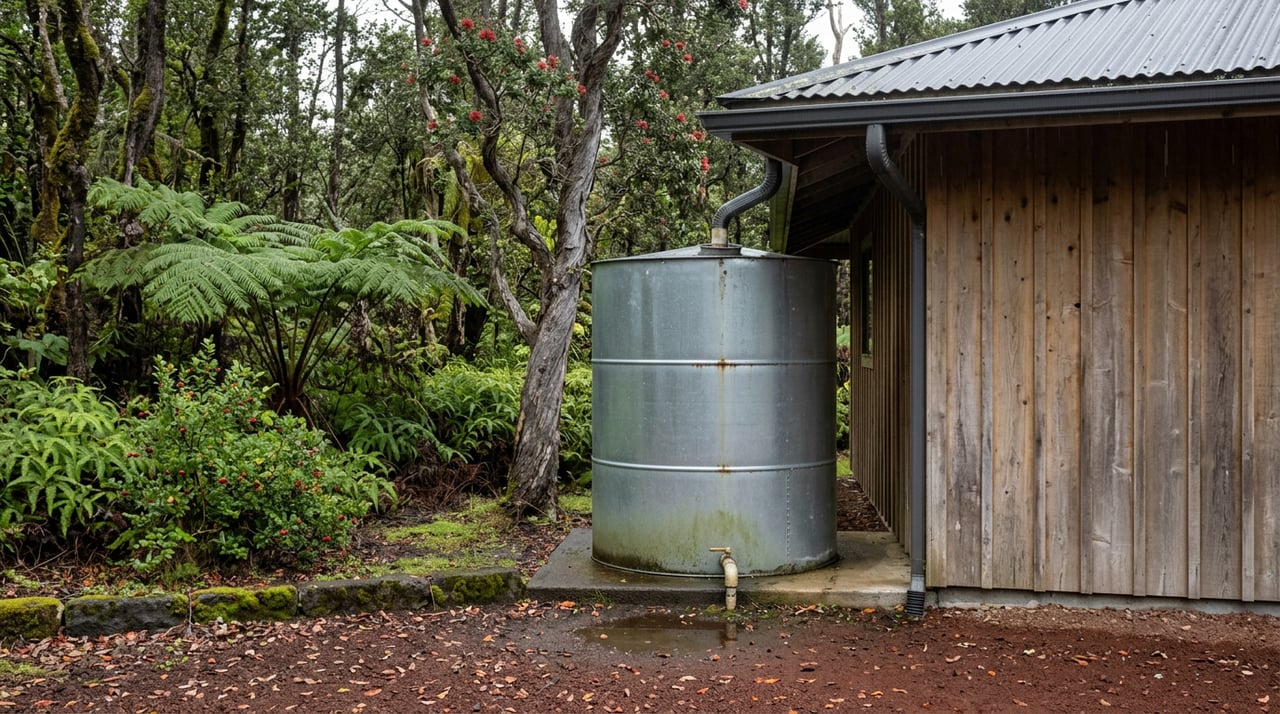
Nearly every home in Volcano relies on rooftop rainwater catchment rather than county water, which isn't a defect so much as standard infrastructure for the district. It does come with its own costs and its own paperwork. Buyers using VA, FHA, or USDA financing need a certified water quality test before the loan can close, and if the water fails, the options are limited to seller-funded treatment upgrades and a retest, not a waiver. Most insurers also want to see tank capacity of at least 8,000 gallons before they'll write a policy at all.
Then there's wastewater. Hawaiʻi's Act 125, passed in 2017, requires every cesspool in the state to be upgraded, converted to septic, or connected to sewer by January 1, 2050, according to the Environmental Protection Agency. Volcano's older subdivisions date to the 1960s and 1970s, and a meaningful share of that housing stock is still running on original cesspools. Conversion typically runs $20,000 to $50,000 or more depending on terrain and access, and while the state dropped earlier proposals to require conversion at the point of sale, lenders and appraisers are increasingly treating an unconverted cesspool as a negotiating point rather than a footnote. A buyer comparing two otherwise identical listings should expect the one with a documented septic conversion to command a real premium over the one still running a cesspool, even if the sale price on paper looks similar today.
So Is $417,000 Actually a Deal?
Here's the reframe worth sitting with: Volcano's median price is low because the buyer pool is small, not because the housing stock is weak. Cash buyers, HPIA policyholders, and the handful of lenders who'll touch Zone 2 property make up a much thinner market than the one bidding on comparable homes in Hilo's low-risk zones, and a thinner buyer pool shows up in the data as slower sales and softer prices. That's the mechanism behind the 90-day median time on market. It isn't that fewer people want to live in Volcano. It's that fewer people can clear the insurance and financing hurdles to make an offer stick.
For a buyer who can clear those hurdles, whether through cash, a specialist lender, or a clear-eyed insurance budget from the start, that thin market cuts the other way. Less competition means more negotiating room and more time to do real diligence before removing contingencies. For a future seller, the same mechanism means pricing and marketing a Volcano property well requires reaching the specific slice of buyers who already understand this math, not the broader pool who'll walk away the moment an insurance quote lands in their inbox.
A Few Quick Questions
Does every home in Volcano require HPIA insurance? Not necessarily. Lava zone boundaries are parcel-specific, and some Volcano addresses may fall into Zone 3, where a smaller number of private carriers still write policies. Confirm your exact zone before assuming either way.
Can I still get a VA loan on a catchment home here? Yes. A 2014 policy shift opened VA backing to Hawaiʻi properties with rainwater catchment, but the lender must order a certified water quality test as part of the appraisal, and the water has to pass before the loan can close.
Will an active cesspool disqualify me from financing? It won't automatically disqualify a buyer, but expect closer lender scrutiny and plan to negotiate a credit or price adjustment that reflects the eventual conversion cost rather than treating it as a problem for 2049.
Volcano rewards buyers who do the math before they fall for the view. If you're weighing a purchase here or anywhere else in East Hawaiʻi and want a straight read on what a specific property's zone, water source, and wastewater system actually mean for your financing, Tessie Fontes has walked local buyers through exactly this process for over a decade. Let's connect: get local guidance or a home valuation.
