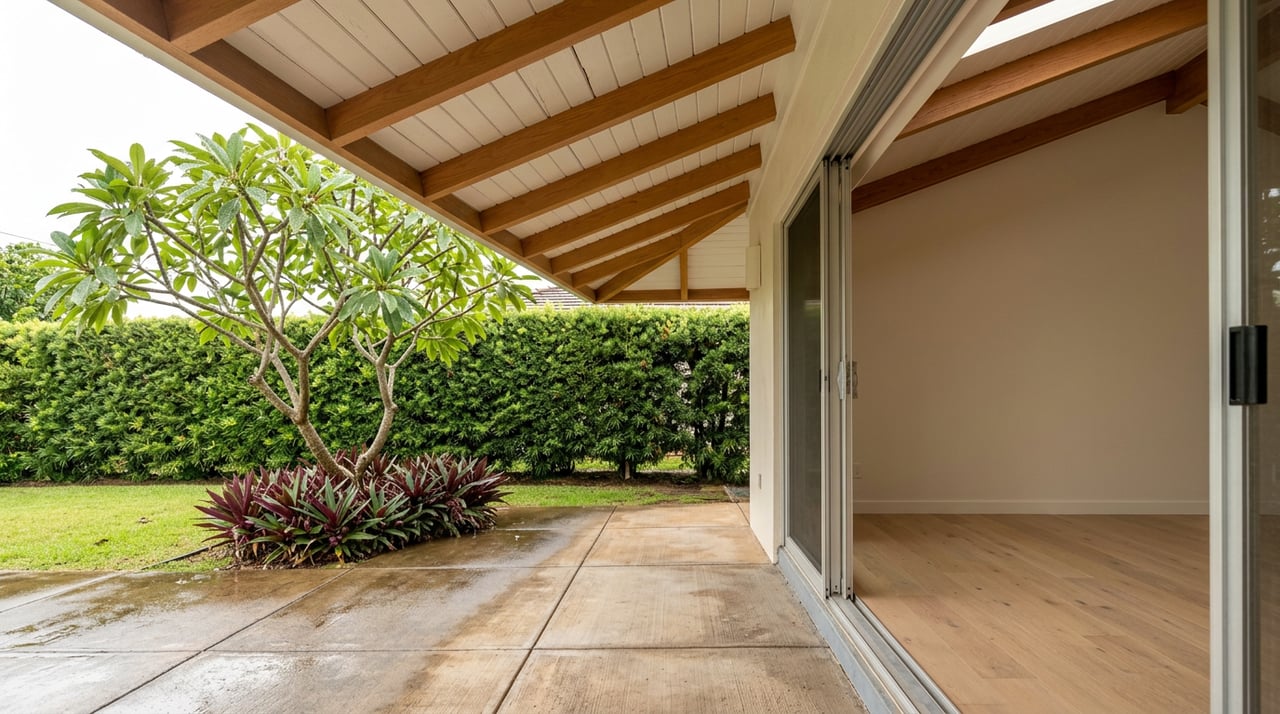
A buyer walks through a plantation-era bungalow near Puueo, falls for the mango tree out back and the ohia floors underfoot, and asks the question every East Hawaii agent expects sooner or later: is this home on sewer or septic? The honest answer, more often than not in Hilo, is neither. It's a cesspool, an unlined pit that sends raw wastewater straight into the ground beneath the property.
That conversation happens constantly here, because Hilo carries a distinction most buyers never expect to learn about a place they're falling for. According to a December 2024 town hall presentation cited by Civil Beat in 2025, Hilo is the nation's largest "unsewered" city, with up to 70% of its houses still relying on cesspools. Everyone points to the year 2050, the statewide deadline for eliminating them, as the number that matters. For anyone actually buying or selling in Hilo this year, it's close to the wrong number entirely. What decides whether a specific transaction goes smoothly is not a calendar date decades out. It's whether that one parcel trips a trigger that moves the timeline up, sometimes by years, sometimes overnight.
Why 2050 Is the Wrong Number to Watch
Act 125, passed in 2017, requires cesspools statewide to be upgraded, converted, or connected to sewer by January 1, 2050. As of the most recent reporting this year, that remains the statewide deadline written into law. But treating 2050 as the operative date for your own purchase misses how these transactions actually unfold on the ground. Lenders do not wait for a legislative deadline to change how they underwrite a file. Renovation permits do not wait either. The distance between the law on paper and the math in a given escrow is exactly where Hilo buyers and sellers get caught off guard.
A handful of things move faster than the statewide clock. Adding a bedroom, bathroom, or kitchen, the kind of project many buyers plan the moment they close, can trigger an immediate wastewater upgrade requirement under current Department of Health rules, independent of any future date. A cesspool can be flagged for correction long before 2050 arrives. And large-capacity cesspools, the kind historically shared by more than one unit, have already been banned outright under federal rules since 2005, according to the EPA. Financing a property with one of those isn't a future problem. It's a right-now problem.
"You know, we have this deadline of Jan. 1, 2050, to convert these cesspools. Well, what happens when 80% to 90% of the families in Hawaii cannot afford the cost of the $30,000 to $50,000 it may take?"
House Speaker Nadine Nakamura said that this July, the same day Governor Josh Green signed House Bill 1618 into law, according to the Hawaii Tribune-Herald. The bill creates a cesspool conversion revolving loan fund, administered by the Hawaii Green Infrastructure Authority, to help homeowners cover exactly that kind of cost.
The Number That Should Worry You More Than the Deadline
About 49,000 cesspools are scattered across Hawaii Island, and a Department of Health analysis reported this month by Hawaii Public Radio flagged Keaau, Hilo, and Kona specifically as places where cesspool contamination may threaten drinking water resources or nearshore coral reefs. To hit the 2050 deadline, Hawaii County would need to convert roughly 2,000 cesspools every year starting now. Carollo Engineers, the firm the county hired to study the problem, put the total cost of eliminating the island's cesspools somewhere between $2 billion and $5 billion, depending on whether the county leans toward individual septic conversions or larger shared sewer systems. Chris Laude, the acting division chief for the county's Department of Environmental Management, described the price tag to HPR as astronomical.
None of that money is earmarked for any specific parcel. Run the pace math and it becomes clear why: converting 2,000 systems a year against tens of thousands of properties means most Hilo homes on cesspools today will still be on cesspools in five or ten years. That's the real reason the property-specific triggers matter more than the statewide finish line if you're buying or selling this year rather than in 2049.
| What shows up on a property | What it actually means for your transaction |
|---|---|
| No wastewater record on file with the county | Doesn't confirm the home has no cesspool. It means more digging is needed before you write an offer. |
| A DOH priority zone flag on the cesspool map | Signals higher environmental risk near drinking water or shoreline. |
| A recent bedroom, bathroom, or kitchen addition | Can trigger an immediate wastewater upgrade requirement, regardless of the 2050 timeline. |
| A large-capacity or shared cesspool serving more than one unit | Already prohibited under federal rules since 2005. Financing is effectively unavailable until it's closed. |
Where the County's Money Is Actually Going
The same afternoon Governor Green signed the loan fund bill, he also signed Senate Bill 2001, introduced by Senator Lorraine Inouye, creating the Banyan Drive Community Development District to revitalize the long-neglected Waiakea Peninsula in Hilo. Hilo's wastewater troubles and its redevelopment ambitions trace back to the same aging infrastructure. According to Civil Beat, the county's municipal wastewater treatment plant has been rated by the EPA as one of the worst in the nation, and Mayor Kimo Alameda signed an emergency proclamation in February 2025, renewed that June, authorizing emergency action if the plant fails outright. The county has since signed a $337 million contract with Nan Inc. to rebuild it.
Civil Beat reported that Alameda has pointed to Hawaii's new green fee, a 0.75 percentage point increase to the state transient accommodations tax that took effect this year and is projected to raise about $100 million annually, as one possible source of homeowner conversion aid, though he has argued a portion should be directed that way rather than assuming it. He has also convened a task force that includes Arizona State University's Asner and directed the county's environmental management department to produce a countywide wastewater plan. Separately, County Council member Heather Kimball has been working with the nonprofit Wastewater Alternatives and Innovations on a community-scale project in Miloliʻi, testing whether a shared decentralized system could work for smaller communities that will likely never see municipal sewer lines.
For a buyer or seller, the useful takeaway isn't the policy detail itself. It's the direction the money is moving. Right now, infrastructure dollars in Hilo are flowing toward the bayfront and toward small pilot projects, not toward a blanket subsidy for every cesspool in town. The state's new loan program launched with a $2 million seed appropriation against a problem Carollo priced in the billions. If you're counting on public money to offset a conversion cost, understand that the current version of that help is still being built out.
What to Actually Do Before You Write an Offer
- Request the county's wastewater record for the parcel using its Tax Map Key. For East Hawaii properties, that request goes through the Hilo Wastewater Branch office under the state's Department of Health wastewater program. No record on file doesn't mean no cesspool. It means you need to look further.
- Confirm the system in person, not just on paper. A home inspector can often locate a cesspool lid directly, or trace the plumbing with a camera if it has been buried or paved over.
- Ask your lender directly whether they will underwrite a home with an active cesspool, and what documentation they will want before closing.
- Check the parcel against the state's cesspool prioritization map, understanding it as a screening tool for environmental risk, not proof of a legal deadline.
- If your plans include adding a bedroom, a bathroom, or an accessory dwelling unit, price the wastewater upgrade into your budget before you file for permits, not after.
A Few Quick Questions
Does every home in Hilo have a cesspool? No. Newer construction and homes already connected to municipal sewer are outside this conversation entirely. But with an estimated 70% of Hilo houses on cesspools as of the most recent local reporting, the odds favor asking the question on nearly anything built before recent decades.
Will a cesspool block my mortgage? Not automatically. What can stop financing outright is a large-capacity or shared cesspool, prohibited since 2005, or a system your lender's underwriter flags during review. Ask before you're deep into escrow, not during it.
Is there financial help available for conversion? The current option is the Cesspool Conversion Revolving Loan Program created by House Bill 1618, administered by the Hawaii Green Infrastructure Authority. As of its 2026 rollout, the fund is still being built out and started with a modest $2 million appropriation.
None of this makes a Hilo home a poor choice, and it doesn't turn selling one into something adversarial. It simply means the paperwork looks different here than it would in a city with a century of sewer lines already in the ground, and the buyers and sellers who ask the right questions early are the ones who avoid a surprise at the closing table. If you're weighing a purchase in Puueo, Keaukaha, Panaewa, or anywhere else in East Hawaii where a cesspool might be part of the picture, Tessie Fontes can walk you through what a property's wastewater history means for your specific situation before you write an offer or sign a listing agreement. Let's connect for local guidance or a home valuation.
This article is general information, not legal, tax or financial advice. Consult a qualified professional about your situation.
