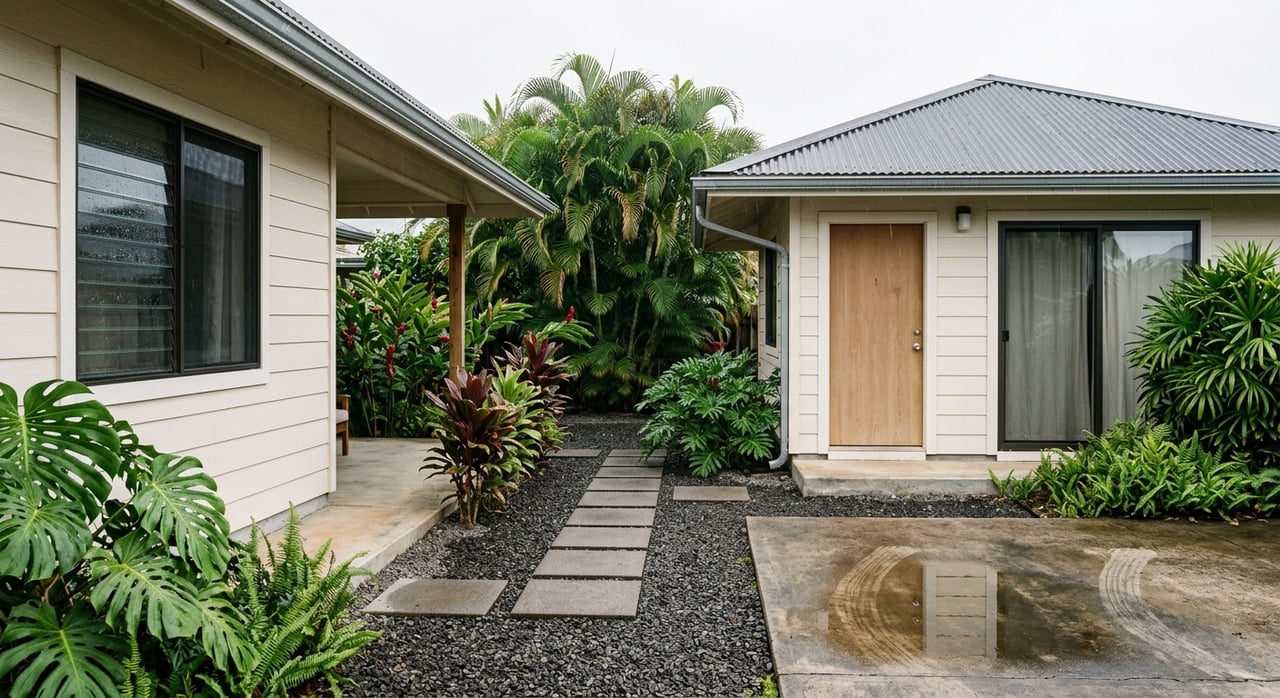
Wondering if an ohana unit in Hilo can give your family more space, create rental income, or both? You are not alone. Many Big Island property owners look at a second dwelling as a practical way to support multigenerational living or make better use of their land, but the rules matter. This guide breaks down what Hawaiʻi County allows, what to check before you make plans, and how to think through family or rental use in Hilo. Let’s dive in.
What an ohana unit means in Hilo
In Hawaiʻi County, the current code uses the term accessory dwelling unit, or ADU. You may still hear people call it an ohana unit, and the County planning site still refers to an Ohana Dwelling Permit when describing the application for a second home on residential property.
An ADU is defined by the county as a structure, or part of a structure, for single-family residential use that may be attached to or detached from an existing residence and contains one kitchen. In simple terms, that means it is a real second dwelling, not just an extra bedroom or guest area.
Where ADUs are allowed in Hilo
Hawaiʻi County allows ADUs on building sites in the RS, RD, RA, FA, and A zoning districts. If a property is in the State land use agricultural district, farm dwelling requirements still apply.
ADUs are not allowed everywhere. They are not permitted in the State conservation district, in certain affordable housing projects with preemptions, or where a change-of-zone ordinance specifically prohibits a second dwelling unit.
If you own an older Hilo property, it is smart to confirm that your parcel is a legal building site and that it meets the zoning district’s minimum site area and yard standards. A lot may look large enough at first glance, but layout and setbacks can affect whether an ADU will fit.
Key ADU rules to know
Before you decide whether an ohana unit makes sense for your property, start with the county basics.
ADU size limit
An ADU can have up to 1,250 square feet of living area. That square footage does not include a lanai, garage, or carport.
Attached or detached options
The unit may be attached or detached from the main home. The county also allows a duplex-style arrangement with a common wall or a shared floor and ceiling.
Height and site limits
The ADU cannot exceed the height limit of the zoning district. The site also needs compliant sewage disposal and water service before the unit can be used.
Number of ADUs allowed
Density is capped at three ADUs per building site, with an exception for sites that are allowed more than one primary dwelling. That is one reason site-specific review matters before you move too far into design ideas.
Utility and inspection requirements
An ADU is not just a design project. It is also a utility and permitting project.
The county requires compliant sewage disposal and water service. Water may come from public or private service, rain catchment, or a private well, as long as County and State requirements are met.
A final inspection is required before the ADU can be used as a dwelling. That means your timeline should include more than just construction. You also need to plan for approvals and final sign-off.
Using an ohana unit for family
For many Hilo owners, the biggest appeal of an ohana unit is flexibility for family living. Because the county allows a self-contained unit with its own kitchen, an ADU can create a more independent setup for relatives while still keeping everyone on the same property.
That can be useful for multigenerational living, a caregiver arrangement, or simply giving family members their own day-to-day space. You get proximity without necessarily sharing every part of the main house.
Still, the lifestyle side matters as much as the legal side. Before building, think through how people will move around the property, where entrances will be, how outdoor areas will be shared, and what utility usage may look like over time.
Privacy is another big factor. Even when a lot technically allows an ADU, the best layout for family use will depend on where you place the unit, how close it sits to the main home, and how parking and walkways affect daily life.
Parking and site planning in Hilo
Parking is one of the most important practical issues for an ADU in Hilo. The ADU follows the county’s general off-street parking rules, and single-family and duplex dwellings are listed at two parking spaces per dwelling unit.
In RS, RA, FA, and A districts, the county does not require paving for those parking areas. However, the surface material must prevent erosion, mud, and standing water.
That matters on many East Hawaiʻi properties, where rainfall and site conditions can change how usable a parking area really is. A plan that works on paper may need more thought on the ground.
Using an ohana unit as a rental
If your goal is rental income, the first thing to understand is that long-term rental use and transient rental use are not the same thing. You should not assume that any ADU can automatically be used for short-term stays.
County code says that no more than one ADU may be used as a transient accommodation rental, and only if there are no other transient rentals on the same site. Hawaiʻi County regulates short-term vacation rental use separately, so the use category and permit path need to be confirmed before you move forward.
For many owners, that means a long-term lease may be the simpler path to explore first. Either way, the right answer depends on the property, zoning, site conditions, and the county approval process.
Deed restrictions and HOA questions
Some buyers and owners worry that private restrictions will block an ADU plan. Under county code, unless a restriction was part of an approval under the code or subdivision chapter, a deed restriction, covenant, HOA bylaw, or similar recorded after October 7, 2024, may not limit or prohibit the construction of ADUs.
That said, this is still an area where you want careful review. Recorded documents, permit history, and project approvals can all affect what is possible on a specific property.
Permit workflow in Hilo
When you are ready to explore an ADU, the local permit path is important. The Planning Department’s land-use permit page lists the Ohana Dwelling Permit as the application to build a second home on residential property.
For East Hawaiʻi, the planning office is in Hilo at Aupuni Center, 101 Pauahi Street, Suite 3. Because ADU approvals are local and site-specific, it is wise to confirm zoning, permitting, utility capacity, and tax treatment with County staff and qualified professionals before making final decisions.
It is also important to be careful with older online information. Some legacy planning summaries still refer to older standards, so current County code should be your main guide.
What buyers should look for
If you are shopping for a Hilo property with plans for an ohana unit, a little early homework can save time and money later. Not every lot that looks promising will work the way you hope.
Here are a few smart questions to ask early:
- What is the property’s zoning district?
- Is it a legal building site?
- Does the lot meet current site area and yard standards?
- Is there adequate sewage disposal and water service?
- Where could required parking realistically go?
- Would your intended use be family occupancy, long-term rental, or transient rental?
These questions can help you narrow your search and avoid falling in love with a property that does not fit your goals.
Why local guidance matters
ADU planning in Hilo is about more than reading one rule or square footage limit. You are balancing county code, lot layout, utilities, parking, and how you actually want to live or invest on the property.
That is where local experience helps. If you are buying, selling, or evaluating a Hilo property with ohana unit potential, having someone who understands East Hawaiʻi neighborhoods, site conditions, and the questions to raise early can make the process much smoother.
Whether you want room for family, a more flexible property setup, or a rental strategy that fits county rules, the best next step is to start with clear facts and a realistic property review. If you want help evaluating your options in Hilo, connect with Tessie Fontes for local guidance you can trust.
FAQs
What is an ohana unit in Hilo, Hawaiʻi?
- In Hawaiʻi County, an ohana unit is generally referred to in current code as an accessory dwelling unit, or ADU, which is a self-contained single-family dwelling with one kitchen that may be attached to or detached from the main home.
Can an ohana unit in Hilo be detached from the main house?
- Yes. Hawaiʻi County allows ADUs to be either attached to or detached from the existing residence.
How big can an ADU be in Hilo?
- The county allows up to 1,250 square feet of living area, not counting lanai, garage, or carport space.
Does a Hilo ohana unit need parking?
- Yes. The county’s general off-street parking rules apply, and single-family and duplex dwellings are listed at two parking spaces per dwelling unit.
Can you rent out an ohana unit in Hilo?
- Potentially, yes, but rental use depends on the type of rental. Long-term use and transient rental use are treated differently, so you should confirm the allowed use and permit path with the county.
Where do you apply for an ohana dwelling permit in Hilo?
- The Planning Department lists the Ohana Dwelling Permit as the application for a second home on residential property, and the East Hawaiʻi planning office is located at Aupuni Center, 101 Pauahi Street, Suite 3, in Hilo.
